
What Idaho Medical Facility Managers Need to Know About Air Duct & Carpet Cleaning.
How often should commercial buildings in the Treasure Valley have their air ducts cleaned? For most commercial spaces, every three to five years is reasonable. For healthcare facility maintenance managers and other decision-makers responsible for air duct and carpet cleaning programs, medical facility air duct cleaning in Boise is more specific: it starts with inspection-based cleaning under the NADCA ACR 2025 standard, with appropriate containment, HEPA filtration, ICRA-compliant protocols, and audit-ready documentation that supports infection control and healthcare compliance.
High-acuity clinical areas including operating suites, ICUs, and airborne isolation rooms should be inspected annually and cleaned based on documented contamination levels. For waiting rooms, administrative areas, and lower-acuity spaces, every one to two years is the standard.
The frequency matters less than the documentation and process. What a Joint Commission surveyor wants to see is that you have a program, it is inspection-based, and every service produced a record. This guide focuses on cleaning frequencies for healthcare ventilation systems, infection control requirements, applicable standards from ASHRAE, the Joint Commission, NADCA, and CDC, containment and cleaning methods, documentation, carpet cleaning in non-clinical healthcare areas, and how to evaluate vendors in Boise and the Treasure Valley.
That is the difference between medical facility air duct cleaning in Boise done correctly and the same service done by a vendor who does not understand your environment, creating avoidable infection risk, HVAC-related citations, and patient-safety concerns.
The Problem With Most Commercial Cleaning Vendors in Healthcare Settings
Here is what we see when we begin working with healthcare facilities across Boise and the Treasure Valley that have used standard commercial cleaning vendors in the past.
The equipment may be adequate. The personnel are not trained for the clinical environment. Nobody discussed ICRA classifications before the work started. The work was done in occupied areas without proper containment. And the only documentation produced was an invoice.
HVAC compliance failures remain among the most frequently cited deficiencies during Joint Commission surveys, with infection prevention citations appearing in over 77% of hospitals surveyed in 2023 to 2024. That is not a fringe problem. It is the norm. And a significant portion of those citations trace back to inadequate documentation of maintenance activities, not just the absence of cleaning.
A maintenance manager who hires a vendor without healthcare protocol experience does not just risk a dirty duct. They risk owning a contamination event or indoor air quality problem that could have been prevented and that can aggravate asthma and allergy symptoms in patients and staff. That is a fundamentally different category of risk than anything in a standard commercial environment.
Medical facility air duct cleaning in Boise requires a different level of preparation, execution, and documentation than any other commercial setting. Here is what that looks like in practice.
What the Standards Actually Require
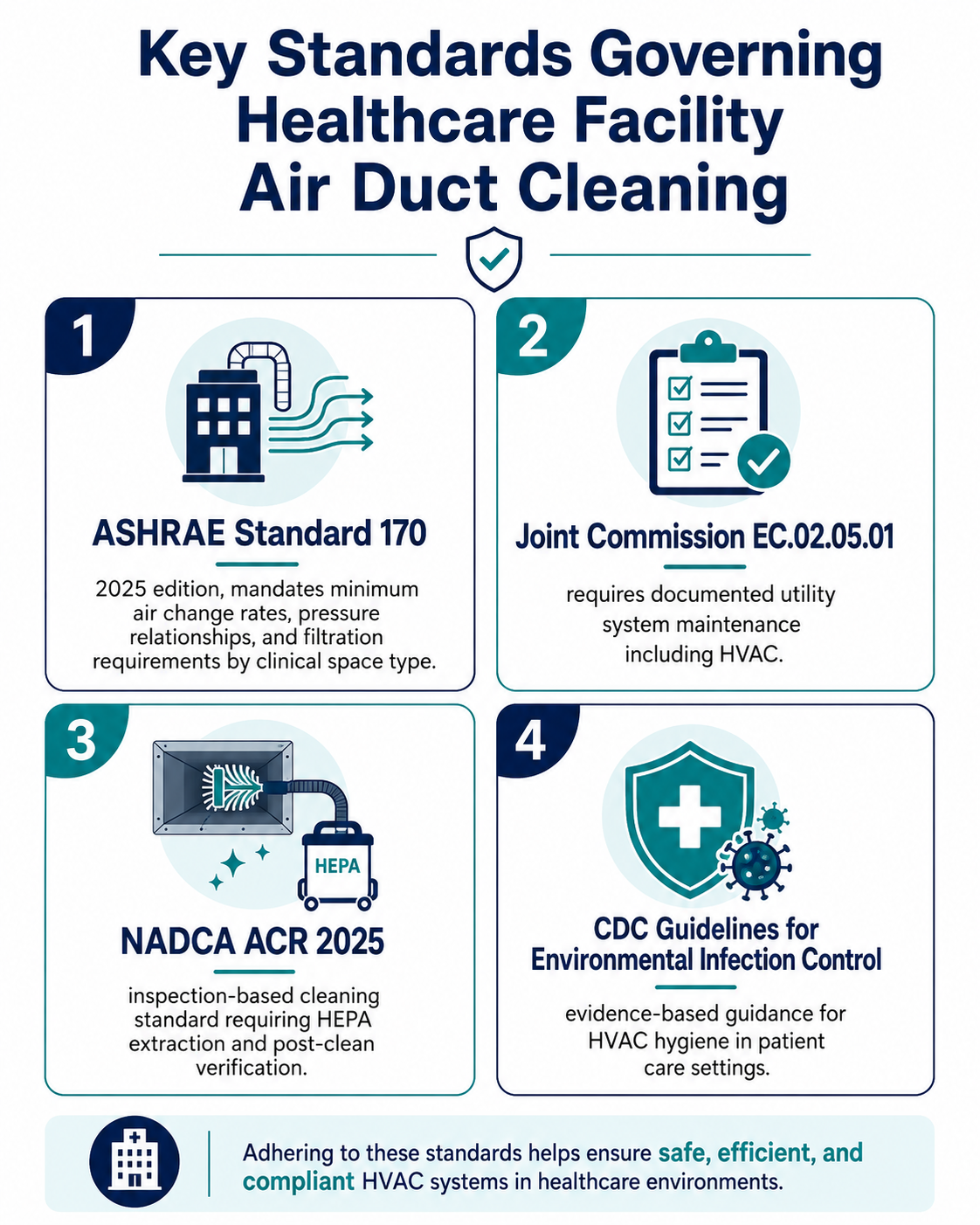
Before any vendor sets foot in your facility, you need to know which standards govern the work. Here are the four frameworks every healthcare facility maintenance manager in Boise and the Treasure Valley should understand.
ASHRAE Standard 170, 2025 Edition
This is the foundational ventilation standard for healthcare facilities. The 2025 edition establishes mandatory minimum air change rates, pressure relationships, filtration requirements, temperature, and humidity ranges for over 60 distinct healthcare space types, from waiting rooms to operating theaters. When duct debris restricts airflow, it can prevent your system from meeting mandated air changes per hour, placing you in technical non-compliance during any survey. The 2025 edition introduced updated requirements for imaging rooms, clarified unoccupied turndown requirements for outpatient spaces, and reorganized ventilation requirements during construction activities.
Joint Commission EC.02.05.01
This Environment of Care standard requires that facilities manage risks associated with utility systems, including HVAC. Documented evidence of proactive maintenance is what surveyors evaluate. A service that happened but was not documented is, for all practical purposes, a service that did not happen. All maintenance activities must be documented and available for inspection by regulatory bodies including The Joint Commission, CMS, and local health departments.
NADCA ACR 2025
The National Air Duct Cleaners Association released an updated Assessment, Cleaning and Restoration standard in 2025. It formalizes an inspection-first methodology: assess contamination levels, then clean based on documented findings rather than fixed calendar intervals. For healthcare facilities, this means annual inspection of air-handling units and critical area ductwork should drive your cleaning schedule, with high-risk zones assessed more frequently and cleaned when contamination exceeds your established threshold. Healthcare-grade duct cleaning under this standard requires physical containment barriers, negative pressurization of the work zone, HEPA-filtered vacuum collection throughout all phases, phased and sectional execution to maintain ventilation continuity, and post-clean verification with particle counts.
CDC Guidelines for Environmental Infection Control in Health-Care Facilities
The CDC's environmental infection control guidance recommends cleaning ventilation ducts as part of routine HVAC maintenance to ensure optimum performance, and specifically addresses the use of portable industrial-grade HEPA filtration in clinical areas where supplemental air cleaning is indicated. Standard commercial methods do not meet these requirements and introduce contamination risk if applied in occupied clinical spaces.
Understanding ICRA Before Any Maintenance Work Begins
This is the piece most commercial vendors miss entirely, and it is the piece that puts your facility most at risk when they do.
An Infection Control Risk Assessment, known as ICRA, classifies the infection risk associated with maintenance or construction activity and defines the engineering controls required to protect patients during that work. ICRA is standard for construction and renovation projects. It is equally applicable to routine duct cleaning, especially in facilities with immunocompromised patient populations. That precaution matters because poor air quality is linked to 1.7 million hospital acquired infections each year.
The four ICRA risk classes define escalating levels of required controls:
Class I: Minor work in non-patient areas. Minimal controls required.
Class II: Work in or adjacent to patient care areas. Requires dust control measures, HEPA vacuuming, and daily cleanup.
Class III: Work that generates dust in areas adjacent to patient care. Requires containment barriers, negative pressure in the work zone, and HEPA filtration of exhausted air.
Class IV: Major work near immunocompromised patients or in high-acuity areas. Requires sealed containment, continuous negative pressure, HEPA filtration of all exhausted air, and post-work verification before area re-occupancy.
Duct cleaning in most healthcare settings falls under Class III or Class IV depending on the proximity to patient care areas and the patient population involved. Any vendor who is not asking about ICRA classification before they begin is not prepared to work in your building.
We coordinate with your infection control team and facilities engineering staff before every healthcare service. ICRA classification determines our containment approach, our equipment configuration, and our scheduling relative to patient occupancy. That coordination is not optional. It is how we protect your patients and your compliance record simultaneously.
What We Do Differently in Healthcare Environments: Air Duct Cleaning Included
We are a female-owned, locally operated business serving the Treasure Valley. We are not a national franchise. We do not send whoever is available. When we work in a healthcare facility in Boise, Meridian, Nampa, or Eagle, we bring a process that is specifically adapted to the clinical environment.
Here is what that looks like in practice for medical facility air duct cleaning in Boise:
Physical containment barriers. We seal off work zones from adjacent clinical and patient areas before any duct access is opened. Containment is established and verified before work begins.
Negative pressure throughout. We maintain negative pressure in the work zone for the duration of the service. This ensures that any dislodged particles or airborne contaminants move toward our extraction system, not toward occupied patient areas.
HEPA-filtered extraction. Our equipment captures 99.97% of particles at 0.3 micrometers throughout all phases of cleaning. What comes out of your duct system stays in our equipment, not in your facility air, including mold spores and bacteria that can contribute to respiratory problems and infections.
Phased and sectional execution. We do not shut down your ventilation system. We work in sections that maintain ventilation continuity throughout the facility, coordinating each phase around your operational schedule and patient occupancy. Proper cleaning also prevents excess buildup on blower wheels and coils that can raise static pressure.
Post-clean verification. We provide visual documentation and particle count data following service. That documentation is formatted for inclusion in your compliance records and is sufficient for accreditation review.
Audit-ready service records. Every healthcare service we perform produces a written record of scope, method, date, areas serviced, equipment used, and findings. You have a document you can put in front of a Joint Commission surveyor with confidence.
For our full air duct cleaning process and what it includes for commercial and healthcare environments, visit our air duct cleaning service page.
The Carpet Question in Healthcare Facilities
Carpet in clinical patient care areas is largely avoided or prohibited under current infection control standards. Maintenance managers already know this. Carpet is porous, difficult to disinfect, and not appropriate where spills, bodily fluids, or airborne pathogens are present.
But carpet does exist in healthcare facilities, and it accumulates the same allergens, biological debris, and particulates as any other carpeted environment, often at higher concentrations given the patient populations moving through the building.
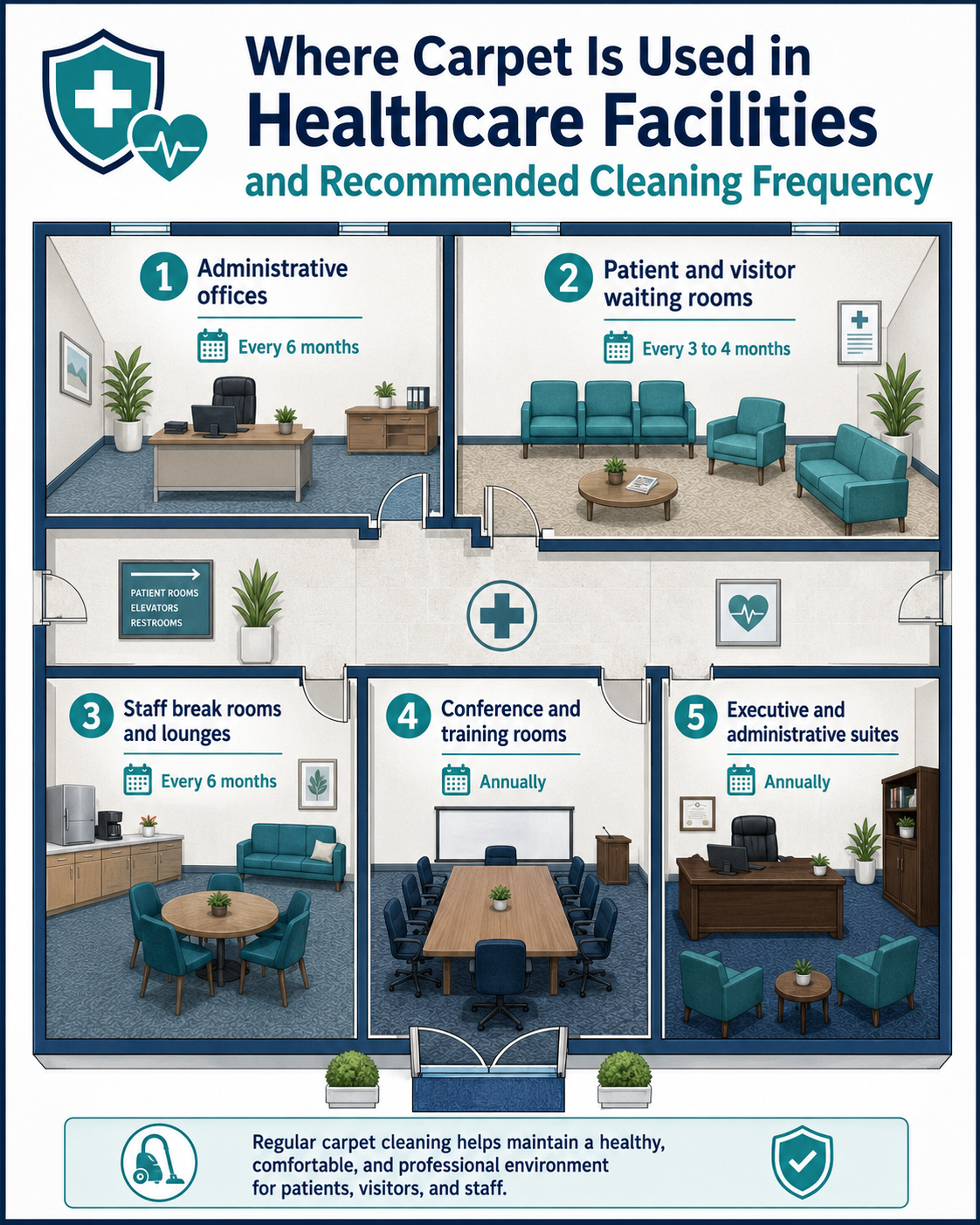
The areas where carpet is used in most Boise and Treasure Valley healthcare facilities, and where professional cleaning matters, are:
Administrative offices and management suites
Patient and visitor waiting rooms and lobbies
Staff break rooms and staff lounges, where daily food use often leads to heavier residue and odor issues
Conference rooms and training facilities
Chapels and family consultation rooms
Executive and administrative suites
These spaces are not clinical. But they are not low-stakes either. A waiting room that smells or presents poorly is the first impression every patient and family member forms about the standard of care in your facility, and carpet is only part of that presentation because floors and furniture also shape how clean the space feels. A staff lounge with deteriorating carpet communicates something about how the organization values its people.
What we are seeing in healthcare facilities across the Treasure Valley is that these non-clinical carpeted areas are consistently the last thing on the maintenance calendar. They get attention when a complaint comes in or when an inspection is approaching. By then, allergen loads have built up, odors have established, and the carpet is showing visible wear that professional cleaning can address but cannot fully reverse, especially when the soil and odor are tied to food traffic rather than clinical activity.
The more effective approach is a scheduled maintenance program. We work with healthcare facility managers in Boise, Meridian, Nampa, and Eagle to establish cleaning frequencies appropriate to each space type and foot traffic level. Waiting rooms used daily by the public warrant more frequent service than a conference room used weekly.
Our commercial carpet cleaning service for healthcare facilities uses a low-moisture, fast-dry process that returns spaces to use within two to three hours. We schedule around your operational hours so administrative areas are clean and fully dried before staff arrive and waiting rooms reopen.
The Cost of Reactive Versus Proactive Maintenance
This is a conversation every healthcare facility maintenance manager has internally and rarely wins quickly enough.
Industry best practices target 70 to 80% preventive maintenance with only 20 to 30% reactive. Facilities hitting 80% or more planned ratios experience 40 to 50% lower total maintenance costs.
The same principle applies directly to your HVAC and carpet maintenance programs. A contamination event traced to a neglected duct system, an HAI investigation that implicates your ventilation, or a Joint Commission citation for inadequate HVAC documentation all cost substantially more in time, resources, and reputational exposure than a proactive scheduled cleaning program. Dirty ducts can also increase operational costs for hospitals. Dirty HVAC systems can raise energy costs by 30%. Regular hvac duct cleaning can extend equipment lifespan and reduce avoidable repair expense.
We help healthcare facility managers in the Treasure Valley build documented maintenance schedules that support a proactive program posture. That includes service records formatted for your compliance files, scheduling that works around your operations, and consistent execution by a local provider who understands what your environment requires.
For a broader look at how air duct cleaning frequency should be determined for different building types and use cases, our post on how often air ducts should be cleaned in Boise commercial and residential buildings covers the full framework.
A Note on What to Ask Any Vendor Before You Hire Them
If you are evaluating cleaning vendors for your healthcare facility in Boise or the Treasure Valley, here are the questions that separate qualified healthcare technicians from standard commercial operators:
Do you understand ICRA classifications and will you complete an ICRA review before beginning work?
What containment method do you use and how do you establish and verify negative pressure in the work zone?
What is your HEPA extraction equipment rated for and how do you verify it throughout the job?
What written procedures do you follow for containment, cleaning, and post-job verification in occupied healthcare areas?
Do you coordinate with our infection control team and facilities engineering before scheduling?
What documentation do you produce and is it formatted for accreditation record-keeping?
Have you worked in occupied healthcare facilities and can you provide references specific to that environment?
Do you perform an on-site inspection before quoting, and are those findings documented?
A vendor who cannot answer those questions directly and specifically is not ready to work in your facility, regardless of price, and vague answers about procedures or site review are disqualifying in a healthcare setting.
Healthcare Facility Cleaning FAQ
How often should hospital air ducts be cleaned in Boise and the Treasure Valley?
Under the NADCA ACR 2025 standard, healthcare facilities should inspect air-handling units and critical area ductwork annually and clean based on documented contamination levels rather than fixed calendar intervals. High-acuity areas including operating suites, ICUs, and airborne infection isolation rooms warrant more frequent assessment. Mold in ducts can contribute to respiratory problems and infections, which is why findings-based cleaning and mold remediation matter. Lower-risk administrative and support areas typically fall on a one to two year cleaning cycle. The key requirement is documentation of the inspection and cleaning decision, not a fixed schedule.
What standards govern medical facility air duct cleaning in Boise Idaho?
The primary standards are ASHRAE Standard 170, 2025 edition, which governs ventilation requirements by clinical space type; Joint Commission EC.02.05.01, which requires documented utility system maintenance; NADCA ACR 2025, which establishes the inspection-based cleaning methodology and equipment requirements; and CDC Guidelines for Environmental Infection Control, which provide evidence-based guidance for HVAC hygiene in patient care settings. Facilities in the Treasure Valley are subject to all four frameworks during Joint Commission and CMS accreditation reviews. These standards matter because neglect of building systems is associated with roughly 1.7 million hospital-acquired infections annually.
What is ICRA and why does it apply to duct cleaning in healthcare facilities?
An Infection Control Risk Assessment classifies the infection risk of a maintenance or construction activity and defines the engineering controls required to protect patients during that work. Duct cleaning in most healthcare environments falls under ICRA Class III or Class IV, requiring containment barriers, continuous negative pressure, HEPA-filtered extraction, and post-service verification before areas are returned to patient occupancy. Any vendor performing duct cleaning in a Boise or Treasure Valley healthcare facility without conducting an ICRA review is operating outside accepted infection control practice.
Does carpet cleaning in a hospital waiting room require special protocols?
For non-clinical areas including waiting rooms, administrative offices, and staff spaces, standard professional carpet cleaning protocols apply with some modifications for the healthcare environment. Low-moisture fast-dry methods are preferred because they return spaces to use within two to three hours rather than requiring extended closure. Cleaning solutions should be non-toxic, low-residue, and safe for the populations using the space. We provide service documentation for all healthcare carpet cleaning appointments, which can be included in facility maintenance records.
Can your team work in an occupied healthcare facility without disrupting patient care?
Yes. We use phased and sectional execution for all healthcare facility duct cleaning to maintain ventilation continuity throughout the facility. Containment barriers and negative pressure fields prevent any contaminants from migrating into adjacent clinical or patient areas during the work. We coordinate scheduling with your facilities team and infection control staff to align with your operational hours and patient census. Most administrative and waiting area carpet cleaning is scheduled for early morning or after-hours to eliminate any disruption to patient-facing operations.
What documentation do you provide after servicing a healthcare facility in Boise?
We provide written documentation of service scope, cleaning method, equipment used, areas serviced, date of service, and any findings or observations made during the work. For duct cleaning, this includes pre and post-service condition notes and is formatted for inclusion in your Joint Commission compliance records. For carpet cleaning, we provide a service record suitable for inclusion in your facility maintenance log. All documentation is provided on the day of service.
Do you service healthcare facilities outside of Boise in the Treasure Valley?
Yes. We provide medical facility air duct cleaning and commercial carpet cleaning throughout Boise, Meridian, Nampa, Eagle, Caldwell, Kuna, and Star, as well as North Idaho areas including McCall and Cascade and East Idaho areas including Sun Valley. We serve facilities ranging from small private practices and dental offices to multi-wing medical centers and specialty clinics across Ada and Canyon Counties.
How do we get started with a facility assessment for our Boise area healthcare facility?
Call us by phone at (208) 989-2999 or submit a facility assessment request through our website. We will schedule a walkthrough of your facility, assess your current duct and carpet maintenance status, review your compliance documentation needs, and provide a clear scope and pricing for a service program that fits your operational requirements.
The Standard of Care Starts With What You Cannot See: The Importance of Indoor Air Quality
Your clinical team maintains extraordinary standards in patient care. Your environmental services team works hard to keep surfaces clean and disinfected. But the HVAC system moving air into every patient room, procedure suite, waiting area, and staff space operates continuously, and what is inside those ducts is circulating through your facility around the clock to help maintain clean air quality and a steady supply of fresh air through the ventilation system.
Medical facility air duct cleaning in Boise is not just a maintenance task. It is a documented component of your infection control program, because neglected duct systems can lead to avoidable contamination, higher operating burden, and poorer air quality. Done correctly, with the right equipment, proper containment, ICRA-appropriate protocols, and audit-ready documentation, it supports every other layer of your infection prevention efforts and holds up under the scrutiny of a Joint Commission survey.
We serve healthcare and commercial facilities throughout Boise, Meridian, Nampa, Eagle, Caldwell, and the greater Treasure Valley. If you want to discuss what a scheduled maintenance program looks like for your facility, call us at (208) 989-2999 or request a facility assessment online. We will give you a clear, honest picture of where your facility stands and what a compliant, documented cleaning program includes through an on-site review by our team.