
What Boise's Air Quality Is Doing to the Inside of Your Home (And What to Do About It)
You closed the windows when the wildfire smoke rolled in. You kept the kids inside during the inversion. You did everything right.
Here is the problem. The EPA has found that indoor air pollutant concentrations are typically two to five times higher than outdoor levels and in some cases up to 100 times worse. The air you were trying to protect your family from outside has been building up inside your home, and your HVAC system has been circulating it ever since.
For Treasure Valley homeowners, this is not a generic concern. Boise faces two specific and recurring air quality events that make indoor air quality a genuine local health issue: wildfire smoke season and winter temperature inversions. Both push harmful particulate matter directly into your home through your HVAC intake, your ductwork, and the fibers of your carpet and upholstery. Most of it never leaves.
This is what we see in homes across Boise, Meridian, Nampa, Eagle, and Caldwell when we do a residential air duct cleaning. The evidence of every smoky summer and every inversion event your family lived through is sitting inside the ductwork, waiting to be redistributed.
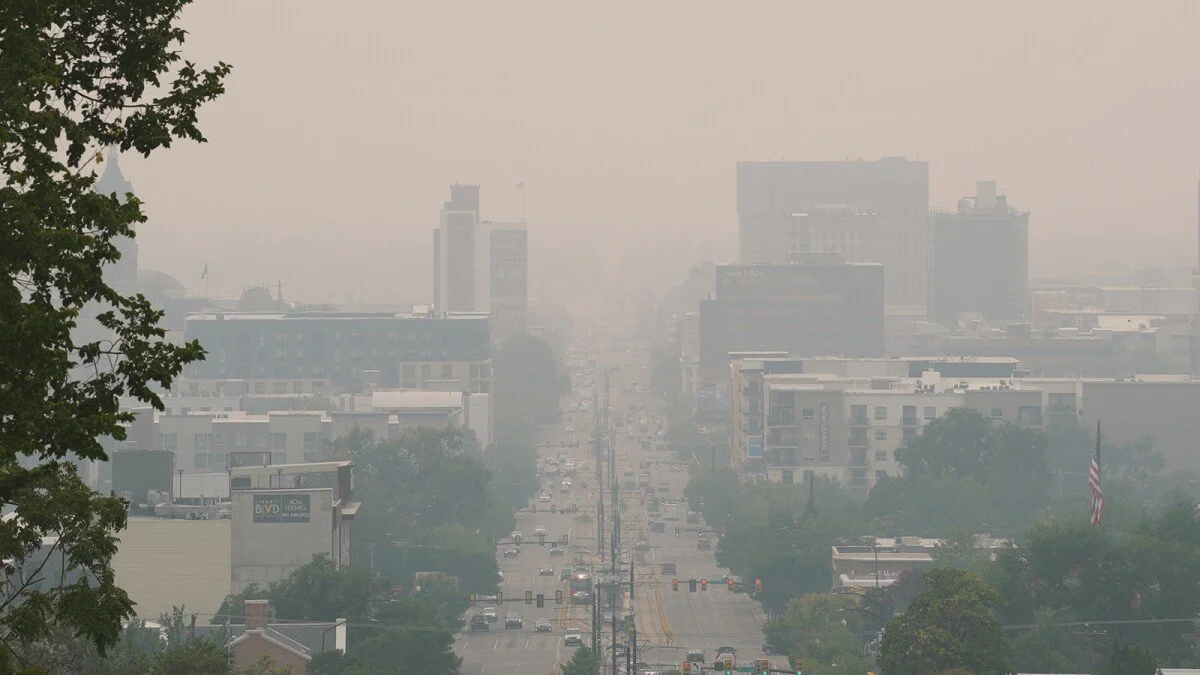
The Two Air Quality Events Treasure Valley Homeowners Face Every Year
Understanding the problem starts with understanding what is actually happening outside your windows at different times of year.
Wildfire smoke season: June through September
Boise sits in a semi-arid basin surrounded by mountains and high desert. Every summer, wildfires burn across Idaho, Oregon, Washington, and northern California. The smoke does not stay near the fires. Fine particulate matter from those fires, known as PM2.5 because the particles are smaller than 2.5 micrometers, travels hundreds of miles on upper-level winds and settles into low-lying valleys like the Treasure Valley.
In August 2020 alone, 500 wildfires burning across Idaho, Eastern Oregon, and Northern California pushed Boise's air quality into the "unhealthy for sensitive groups" category for multiple consecutive days. That is not an isolated event. According to IQAir's monitoring data for Boise, the growing population in the Treasure Valley combined with increasingly severe western wildfire seasons means Boise will continue to face significant high-PM2.5 days annually. Smoke season is not getting shorter.
Winter inversions: November through February
When the wildfire smoke clears, a different problem begins. Boise's location in the Treasure Valley basin makes it highly susceptible to temperature inversions, where a layer of warm air traps cooler, denser air below. Pollutants from wood burning stoves, vehicle emissions, and industrial sources cannot escape the valley. They accumulate at ground level for days or weeks at a time.
According to the Idaho Department of Environmental Quality, the Treasure Valley is subject to these inversion events every winter, with particulate levels typically worst between December and February. Idaho ranks eighth nationally in per capita wood stove pollution, which is a significant contributor to inversion-related air quality degradation. The National Weather Service issues Air Stagnation Advisories for the region regularly during this period.
Two seasons. Two distinct air quality threats. Each one loading fine particulate matter directly into your home.
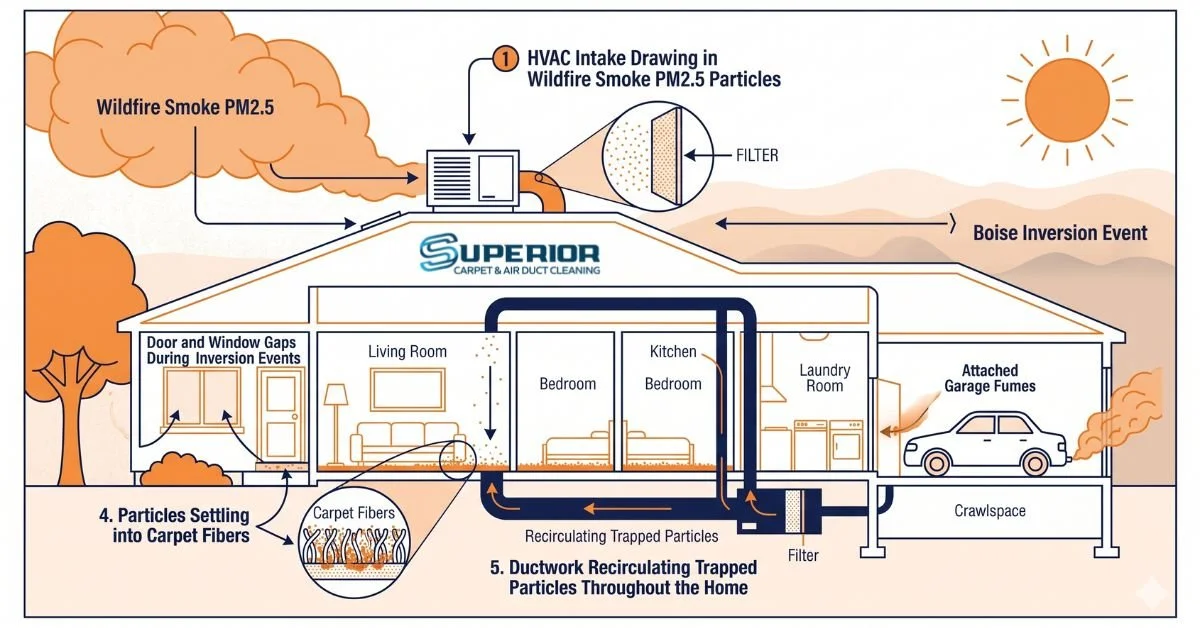
How Outdoor Pollution Gets Inside Your Home and Stays There
This is the part most Boise homeowners do not fully understand. Closing the windows helps. It does not solve the problem.
Your HVAC system is an active intake. Every time your heating or cooling system runs, it pulls air from inside the home, conditions it, and pushes it back through the ductwork. But HVAC systems also draw air from outside through their intake, and during smoke events or inversions, that intake is pulling PM2.5 directly into your system. Standard HVAC filters catch some of it. A significant portion passes through, deposits on the interior walls of your ductwork, and gets redistributed into every room of your home on every subsequent cycle.
Gaps and infiltration points. Even well-sealed Treasure Valley homes have infiltration points: gaps around windows and doors, attic penetrations, recessed lighting, and utility penetrations. During extended smoke or inversion events, fine particles infiltrate through these openings constantly. PM2.5 particles are small enough to behave like a gas, moving through gaps that you would never see with the naked eye.
Carpet as a particle reservoir. Once PM2.5 and other fine particles are inside your home, they settle. And one of the primary places they settle is carpet. Carpet fibers trap and hold particulate matter, pet dander, dust, allergens, and chemical residues from smoke events. According to the Idaho Department of Health and Welfare, carpets can hold moisture and particles for long periods and are specifically identified as a source of ongoing indoor air contamination. Every step your family takes on that carpet redistributes those particles back into the breathing zone.
The compounding cycle. What we see consistently in homes across the Treasure Valley is that outdoor air quality events do not just pass through. They leave a deposit. Smoke from three summers ago is layered in the ductwork alongside last winter's inversion residue and this summer's smoke. Each event adds to what is already there. The HVAC system circulates it. The carpet holds it. The family breathes it.
What You Can Do Right Now: 5 Practical Steps
We are not going to tell you there is nothing you can do between professional cleanings. There is, and it matters.
1. Upgrade your HVAC filter and check it monthly during smoke season. The Idaho Department of Health and Welfare specifically recommends MERV 13 rated filters for homes during wildfire smoke and inversion events. Standard fiberglass filters rated MERV 1 to 4 allow PM2.5 to pass through freely. Upgrading to MERV 13 significantly increases particle capture. During smoke season, check and replace the filter monthly rather than quarterly. A filter that looks clean may already be saturated with fine smoke particles that are invisible to the eye.
2. Keep windows and doors closed during smoke and inversion events. This sounds obvious but the timing matters. Opening windows on a clear day to ventilate is good practice. Opening them during a smoke event or inversion to "air out the house" actively makes indoor air quality worse by introducing outdoor pollutants directly into your living space.
3. Vacuum with a HEPA-filtered vacuum regularly. A standard vacuum without HEPA filtration picks up larger particles and exhausts fine particles back into the room. A HEPA-filtered vacuum captures particles down to 0.3 micrometers, which covers the PM2.5 range. During and after smoke events, vacuuming high-traffic areas and upholstered surfaces daily makes a meaningful difference in airborne particle levels.
4. Use a portable HEPA air purifier in sleeping areas. For families with children, elderly members, or anyone with respiratory conditions, a portable HEPA purifier in bedroom spaces provides meaningful protection during high-pollution periods. This is a targeted step for the rooms where your family spends the most concentrated time.
5. Ventilate intentionally on good air quality days. When the AQI is genuinely good, open windows and create cross-ventilation. This dilutes indoor pollutant concentrations that have built up over smoke and inversion periods. Use the AirNow app or AQI monitors to confirm outdoor conditions before ventilating.
These steps reduce ongoing accumulation. They do not remove what is already in the ducts and carpet from previous seasons. That requires professional service.
What Professional Whole House Duct Cleaning Actually Removes
When we perform residential air duct cleaning in Boise homes, the evidence of past air quality events is visible and measurable.
Wildfire smoke particles that pass through an HVAC filter are oily and adhesive. They do not sit loosely on duct surfaces the way ordinary house dust does. They bond to the interior walls of the ductwork, building up in layers over multiple smoke seasons. They also carry volatile organic compounds and chemical byproducts from combustion that continue to off-gas from duct surfaces into circulating air long after the smoke event ends.
Inversion residue, which includes wood smoke particulates, vehicle exhaust PM2.5, and fine carbon particles, behaves similarly. It deposits on duct walls, on HVAC components, and on the internal surfaces of air handlers and coils.
Our whole house duct cleaning process uses negative pressure equipment that creates a contained vacuum within your duct system. A rotary brush system mechanically dislodges accumulated material from duct walls throughout the full run, including through bends and elbows that standard equipment cannot reach. The extracted material is captured and removed from the home entirely, not redistributed during the process.
For Boise homes that have been through multiple smoke seasons without a duct cleaning, what comes out is not ordinary dust. It is layered, compacted material with visible discoloration from smoke and combustion particles. We have had clients tell us they notice the difference in how their home smells within days of a whole house cleaning, particularly at the start of a new heating season.
Combined with a professional carpet cleaning that removes the particle reservoir in flooring, whole house indoor air quality cleaning addresses both the primary accumulation points simultaneously. For more on what the air duct cleaning process looks like and what it includes, our service page covers the full scope.
Who Should Prioritize This Most
Every Treasure Valley household benefits from addressing indoor air quality after multiple smoke and inversion seasons. Some households have more urgency than others.
Families with children under 12. Children breathe more air relative to their body weight than adults and have developing respiratory systems. Their exposure to accumulated indoor pollutants is disproportionately higher.
Anyone with asthma, COPD, or cardiovascular conditions. The EPA ranks indoor air pollution among its top five environmental health risks. For individuals with existing respiratory or cardiovascular conditions, the accumulation in ducts and carpet is not an abstract concern.
Homes that have not had duct cleaning in three or more years. If your home has been through three or more Boise wildfire and inversion seasons without a whole house duct cleaning, the accumulation is significant.
New homeowners. You do not know what the previous occupants' HVAC maintenance history looked like. A whole house cleaning when you move in establishes a clean baseline.
Our post on whether air duct cleaning is really worth it covers the full value case if you are still weighing the decision.
A Quick Poll: What Is Your Home Situation?
We are curious what Treasure Valley homeowners are actually experiencing. Which of these applies to your home right now?
My home has never had a professional duct cleaning
We had duct cleaning done more than three years ago
We went through multiple smoke seasons with the windows closed and HVAC running
Someone in my household has respiratory issues or allergies
I notice the house smells different when the heat first kicks on in fall
If any of these apply, your indoor air quality is worth a conversation.
Indoor Air Quality Boise FAQ
Is indoor air quality in Boise really worse than outdoor air? According to the EPA, indoor air pollutant concentrations are typically two to five times higher than outdoor levels under normal conditions. In Boise, where wildfire smoke and winter inversions introduce significant PM2.5 into home HVAC systems seasonally, indoor accumulation over multiple years can substantially exceed outdoor levels during non-event periods. The particles do not leave on their own.
Does closing windows during a smoke event protect my indoor air? It significantly helps but does not fully protect your home. Your HVAC system continues to draw in outdoor air through its intake during operation. Fine PM2.5 particles also infiltrate through gaps and penetrations in the building envelope that are invisible to the eye. Upgrading to a MERV 13 filter and reducing HVAC runtime during smoke events provides additional protection.
How often should Boise homeowners have their ducts cleaned? For most Treasure Valley homes, every three to five years is a reasonable baseline. Homes that have been through multiple severe wildfire smoke seasons, have household members with respiratory conditions, or have never been cleaned since construction should prioritize sooner. For how frequency recommendations vary by home type, our post on how often Boise homeowners should clean their air ducts covers it in detail.
Does carpet hold wildfire smoke particles? Yes. Carpet fibers trap and retain PM2.5 and other fine particles from smoke events, along with combustion byproducts and VOCs. The Idaho Department of Health and Welfare specifically identifies carpets as a source of ongoing indoor contamination. Professional extraction removes accumulated material that vacuuming alone cannot reach.
Can HEPA air purifiers replace professional duct cleaning? No. Portable HEPA purifiers are effective at filtering airborne particles in a specific room in real time. They do not remove the deposited material already sitting in your ductwork, on coil surfaces, or in your carpet. Both approaches address different parts of the indoor air quality picture and work best together.
What areas do you serve for residential air duct cleaning? We serve Boise, Meridian, Nampa, Eagle, Caldwell, Kuna, and Star, along with North Idaho areas including McCall and Cascade and East Idaho areas including Sun Valley.
Do you clean both ducts and carpet in one visit? Yes. Many Boise homeowners schedule both services together for efficiency and for a comprehensive approach to whole-home indoor air quality. Combined service is the most effective way to address both primary particle accumulation points at the same time.
Your Home Should Be Your Clean Air Space
The Treasure Valley's outdoor air quality challenges are real and recurring. Smoke season comes every summer. Inversions come every winter. You cannot control what happens outside, but you can control what stays inside.
We provide residential air duct cleaning and carpet cleaning across Boise, Meridian, Nampa, Eagle, Caldwell, and the greater Treasure Valley. If your home has been through multiple smoke and inversion seasons without a professional cleaning, it is time to reset.
Request a free estimate or call us at (208) 989-2999. We will assess your home and give you a clear picture of what a whole house cleaning includes and what it costs.