
Sofa, Sectional, or Dining Chairs: What Professional Upholstery Cleaning Actually Does
Think about where your family spends most of its time at home. It is not the floor. It is the sofa.
You sit on it for hours every day. Your kids do homework on it, eat snacks on it, fall asleep on it. Your pets claim entire cushions as their own. Guests sit on it. And in most Boise homes we visit, it has never been professionally cleaned.
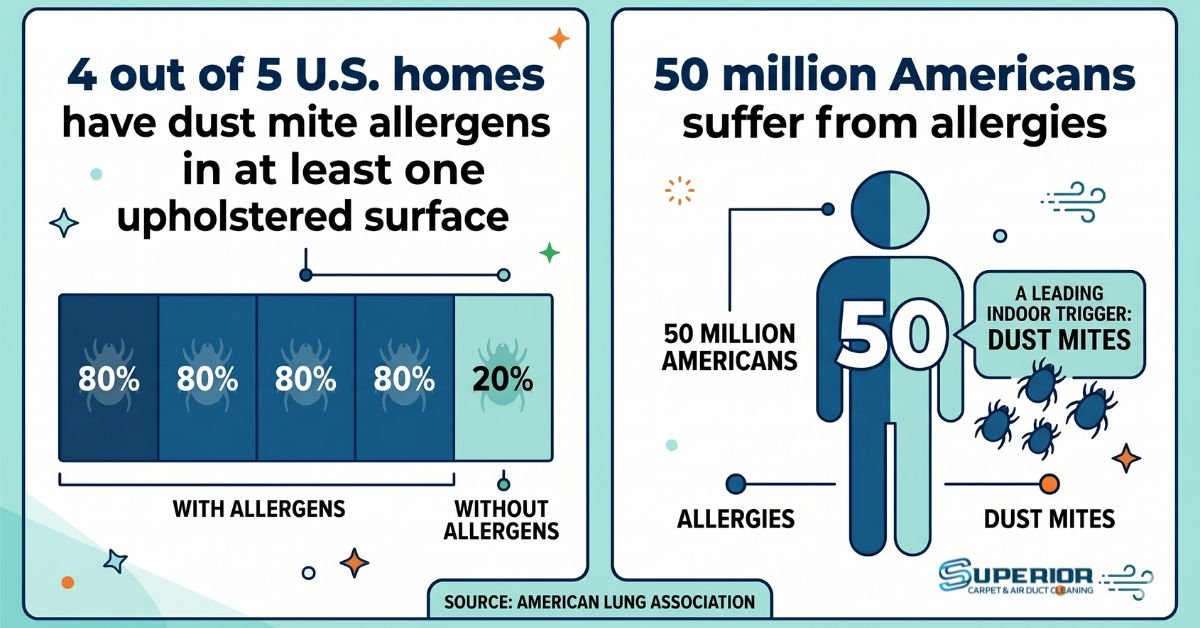
That sofa is not just dirty in the way you might think. It is a biological accumulation point for everything your household produces and everything the outside world brings in. The American Lung Association reports that roughly four out of five homes in the United States have dust mite allergens in at least one upholstered surface, and that dust mites are one of the leading indoor triggers for the 50 million Americans who suffer from allergies. Unlike pet allergens, dust mite allergens do not stay airborne. They settle directly into fabric, where they accumulate undisturbed until something dislodges them back into your breathing space.
Your vacuum helps. It does not reach what is actually in there. Here is what does.
What Is Actually Living in Your Upholstered Furniture
Upholstered furniture is engineered to be comfortable and durable. Those same qualities, deep cushioning, layered fabric, dense filling, make it an ideal habitat for allergens and biological material that surface cleaning cannot address.
Here is what we find consistently in Treasure Valley homes:
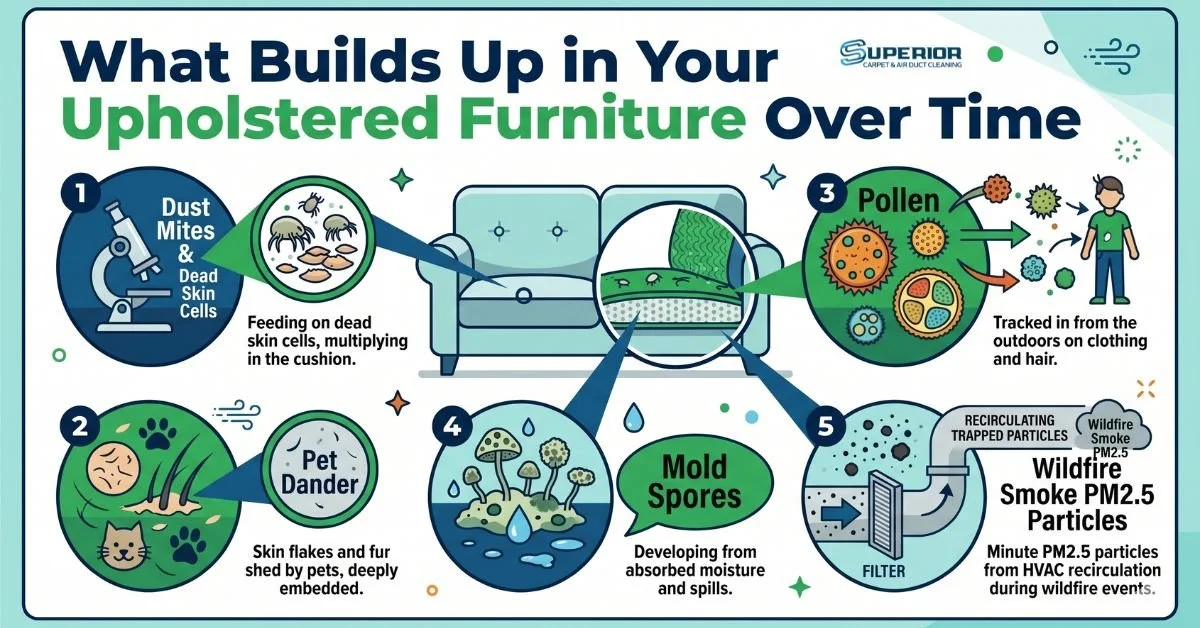
Dust mites. Microscopic arachnids that feed on the dead skin cells your body sheds naturally, averaging between 30,000 and 40,000 cells per hour. Upholstered furniture with its warmth, humidity from body heat, and continuous food supply is a perfect dust mite environment. Their waste proteins are the actual allergen that triggers reactions, and those proteins accumulate in the fabric with every passing week.
Pet dander. Pet dander is not fur. It is microscopic skin flakes shed continuously by cats, dogs, and other animals. Dander is lightweight enough to become airborne when furniture is disturbed and sticky enough to embed in fabric fibers where it stays. Homes where pets do not sit on furniture can still have significant dander accumulation because the particles travel through air and settle on every surface.
Pollen. Every time someone walks in from outside during spring or summer, pollen comes with them, on clothing, in hair, on shoes. It settles into wherever they sit. Boise's high desert environment and proximity to agricultural land means seasonal pollen loads are significant. Once inside your sofa, pollen contributes to year-round allergy symptoms even when the season has passed.
Mold spores. Spills that are not fully dried, humidity from Treasure Valley summer evenings, and moisture absorbed through fabric create conditions for mold growth in sofa padding and backing. Mold spores embedded in furniture release into the air whenever the sofa is used, contributing to respiratory irritation and persistent odors.
Smoke and PM2.5 particles. As we covered in our post on Boise's indoor air quality and wildfire smoke, PM2.5 particles from wildfire smoke and winter inversions circulate through your HVAC system and deposit on every surface in your home, including your upholstery. These particles are oily and adhesive and do not brush off.
Why Your Vacuum Is Not Enough
We are not dismissing vacuuming. Regular vacuuming with a HEPA-filtered vacuum is genuinely useful for surface maintenance and should be part of every household's routine. The limitation is physics.
A household vacuum, even a powerful one with HEPA filtration, operates at suction levels sufficient to lift loose debris from the top layer of fabric. Dust mite allergen particles, deeply embedded dander, pollen that has migrated into cushion fill, and mold that has established itself in the padding below the fabric surface are beyond what any consumer vacuum can extract.
A published study in the National Institutes of Health research database found that while intensive vacuuming produced a significant reduction in dust mite allergen concentration in upholstered surfaces, allergen levels returned to near pre-treatment levels within four weeks. Steam cleaning combined with vacuuming produced reductions that persisted for up to eight weeks. Professional extraction using the right combination of heat, moisture control, and suction power reaches the layers that vacuuming alone cannot.
This is the core reason upholstery cleaning is not optional maintenance for households with allergy sufferers, children, or pets. It removes the source material, not just the surface layer.

What You Can Do Between Professional Cleanings
Before we talk about what professional service does, here is what every Boise homeowner can do in-house to slow the accumulation between visits. These steps matter and we recommend all of them.
Step 1: Vacuum cushions, seams, and crevices weekly with a HEPA-filtered vacuum. Remove cushions and vacuum underneath them. Focus on seams, tufting, and any crevices where debris concentrates. A HEPA-filtered vacuum captures fine particles rather than exhausting them back into the room. Without HEPA filtration, you are redistributing what you vacuum rather than removing it.
Step 2: Spot clean spills immediately. Moisture that sits in upholstery creates the conditions for mold growth and permanently sets stains. Blot, never rub, with a clean white cloth and cold water. For most fabric types, a small amount of mild dish soap diluted in cold water handles the majority of fresh spills safely. Always test a small hidden area first.
Step 3: Keep indoor humidity between 30 and 50 percent. Dust mites cannot survive in low humidity environments. The Idaho Department of Health and Welfare specifically recommends maintaining indoor humidity in this range to limit dust mite and mold growth. Running your HVAC system and using a dehumidifier during Boise's humid summer evenings keeps conditions less favorable for allergen accumulation.
Step 4: Rotate and flip cushions monthly. This distributes wear evenly, improves airflow through cushion fill, and prevents concentrated allergen buildup on the surfaces your family uses most. It extends the usable life of your furniture and reduces the rate of fabric compression in high-use areas.
These steps keep your furniture cleaner between professional visits. They do not replace the deep extraction that removes what has built up below the surface over months and years.
What Professional Upholstery Cleaning Actually Does
When we clean upholstered furniture at Superior Carpet and Air, the process is built around two things that consumer tools cannot replicate: controlled moisture and professional extraction power.
We inspect the fabric type before selecting any cleaning solution. Different upholstery fabrics, including microfiber, cotton, linen, synthetic blends, velvet, and performance fabrics, require different approaches. The wrong solution on the wrong fabric can cause shrinkage, color bleeding, or pile damage. We check the manufacturer's cleaning code on every piece before we begin.
The process for most fabric types works as follows. A pre-treatment solution appropriate for the fabric is applied to break down embedded soil, allergen proteins, and biological material. We then use professional extraction equipment that applies controlled moisture and simultaneously extracts the loosened material along with the liquid used. The combination of heat and suction reaches cushion fill and backing layers that surface cleaning cannot access.
The result is upholstery that is genuinely clean through its depth, not just the surface layer. Dust mite allergen loads are reduced significantly. Pet dander and pollen embedded in the fabric are extracted. Odors from biological material are addressed at the source rather than masked.
Because we use a controlled, low-moisture process, most upholstered furniture is dry within two to four hours. You are not waiting a day to use your sofa again.
Area Rugs: The Forgotten Surface
Upholstery cleaning is often what brings clients to us, and when we arrive we frequently find that the area rugs in the same rooms have also never been professionally cleaned.
Area rugs accumulate soil, allergens, and debris in the same way carpet does, but with some additional challenges. Many area rugs sit on hard flooring where there is no pad beneath them to buffer foot traffic impact. The grit that enters from above is pressed repeatedly into the fiber base. Decorative area rugs often have denser pile constructions that trap material more effectively than standard carpet.
We provide area rug cleaning as part of our upholstery and specialty cleaning services across Boise, Meridian, Nampa, Eagle, and Caldwell. For Oriental and specialty rugs, we assess the fiber and dye structure before selecting a cleaning approach, as these require more careful handling than standard synthetic rugs.
Combining upholstery and area rug cleaning in a single visit addresses the full picture of fabric surfaces in your living spaces and makes the most efficient use of a single service appointment.
How Often Should Upholstered Furniture Be Professionally Cleaned?
This is the question we get most often and the answer varies by household.
For most Boise homes, professional upholstery cleaning every 12 to 18 months is a reasonable baseline. This frequency keeps allergen loads under control and prevents the level of deep accumulation that requires more intensive treatment to address.
Households with the following characteristics should consider every 6 to 12 months:
One or more pets that use upholstered furniture
Household members with allergies, asthma, or respiratory conditions
Young children who spend significant time on upholstered surfaces
High-use furniture in main living areas that sees daily heavy use
For anyone who has never had their upholstered furniture professionally cleaned, regardless of how long you have owned it, that is a reasonable starting point for a first appointment.
A Quick Poll: What Is Your Furniture Situation?
We are curious what Treasure Valley homeowners are actually dealing with. Which of these sounds like your home?
My sofa has never been professionally cleaned
We have pets that use the furniture daily
Someone in the household has allergies or asthma
There is a smell I cannot identify and cannot get rid of
My dining chairs have visible buildup in the seams and fabric
If any of these apply, upholstery cleaning is worth a conversation.
Upholstery Cleaning Boise FAQ
How often should I have my upholstery professionally cleaned? For most Treasure Valley households, every 12 to 18 months is a good baseline. Homes with pets, allergies, or young children benefit from every 6 to 12 months. If furniture has never been professionally cleaned, start there regardless of its age.
Is professional upholstery cleaning safe for all fabric types? We inspect and identify the fabric type and manufacturer cleaning code before selecting any product or method. Different fabrics require different approaches and we adapt accordingly. We do not use a single method on every piece of furniture.
How long does upholstery take to dry after cleaning? Most upholstered furniture is dry within 2 to 4 hours using our controlled, low-moisture extraction process. We do not over-saturate fabric, which eliminates the risk of extended moisture sitting in cushion fill.
Can professional cleaning remove pet odors from upholstery? Yes, in most cases. Pet odors originate from dander, urine, and biological residue embedded in fabric and cushion fill. Professional extraction removes the source material rather than masking the odor. Severe cases where urine has penetrated deeply into cushion fill may require additional treatment, which we assess before cleaning.
Do you clean area rugs as well as upholstered furniture? Yes. We provide area rug cleaning throughout Boise, Meridian, Nampa, Eagle, and Caldwell. Many clients schedule upholstery and area rug cleaning together in a single visit. For specialty and Oriental rugs, we assess fiber and dye structure before proceeding.
What upholstery fabrics do you clean? We clean microfiber, cotton, linen, synthetic blends, performance fabrics, and most standard upholstery materials. We assess velvet, silk blends, and specialty fabrics individually. We will tell you honestly if a piece requires a different approach or if cleaning carries a risk to a particular material.
What areas do you serve for upholstery cleaning? We provide upholstery cleaning in Boise, Meridian, Nampa, Eagle, Caldwell, Kuna, and Star, along with North Idaho areas including McCall and Cascade and East Idaho areas including Sun Valley.
The Most Used Surface in Your Home Deserves the Same Attention as Your Floors
Most Boise homeowners think about carpet cleaning before they think about upholstery. But your sofa gets more hours of direct contact with your family than your carpet does. It holds the same allergens, the same biological accumulation, and the same outdoor contaminants that your carpet holds, often in higher concentrations because it is closer to where you breathe.
If you have questions about what professional upholstery cleaning involves for your specific furniture, or if you want to schedule a visit, give us a call at (208) 989-2999 or request a free estimate online. We serve homes and businesses across the Treasure Valley and will give you a clear, honest assessment of what your furniture needs.
For more on how we approach carpet and fabric cleaning across the home, visit our carpet cleaning service page for the full picture.