
Pet Stains, Odors, and the Truth About What's Actually Living in Your Carpet
You cleaned it up. You used the spray. You blotted it dry, maybe even rented a machine. It looked fine.
Then a warm day hit. A guest walked in. Your dog found the same spot again.
Sound familiar? You are not alone. This is one of the most common things we hear from pet owners across Boise, Meridian, and Nampa, and it is not a reflection of how clean you keep your home. It is a reflection of what is happening below the surface of your carpet that no spray bottle or rental machine can reach.
Here is the truth about pet stains, what you can do yourself, and when it is time to call in equipment that actually solves the problem.
Why Pet Accidents Are Not Just a Surface Problem
When a pet urinates on carpet, less than a third of it stays in the fiber you can see and touch. The rest wicks downward immediately, moving through the carpet backing and into the pad below. In many cases it reaches the subfloor.
The surface dries. The spot disappears. But the urine in the pad does not evaporate the way surface moisture does. It sits there, and over time the bacteria in that urine break down uric acid crystals into gases. Those gases are what you smell, and they intensify with heat and humidity. That is why summer is when Boise pet owners suddenly realize the problem they thought they solved months ago is still very much alive.
According to the EPA's indoor air quality research, biological contaminants including pet dander, bacteria, and mold from moisture are among the most common indoor air quality problems in American homes, with carpets acting as a primary reservoir.
We have helped hundreds of clients across the Treasure Valley who have been fighting the same stain for months. The issue is almost never the carpet fiber. It is what is underneath it.
What You Can Do Yourself: 5 DIY Steps That Actually Help
We are not here to tell you that home treatment is useless. Done correctly and quickly, it genuinely limits how deep an accident penetrates. Here is what we recommend to every client as a first response.
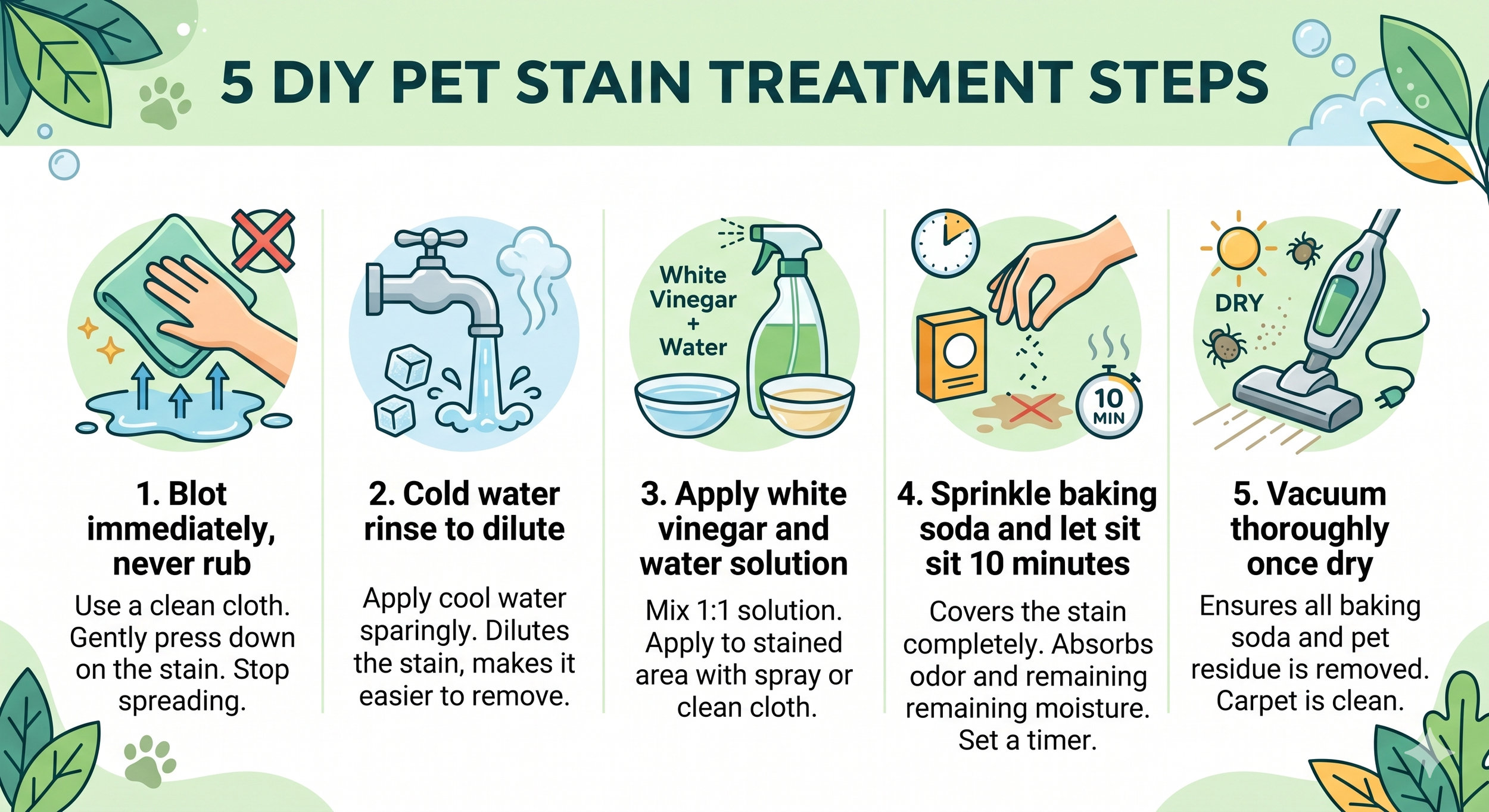
1. Blot immediately. Never rub. Rubbing spreads the urine laterally and pushes it deeper into the fiber. Use a clean white cloth or paper towels and press straight down, working from the outside of the stain toward the center. Blot until no more moisture transfers to the cloth.
2. Rinse with cold water. Cold water dilutes what is left in the fiber. Pour a small amount directly on the stain and blot again. Never use hot water, it sets the proteins in urine and makes the stain harder to remove.
3. Apply a white vinegar and water solution. Mix equal parts white vinegar and cold water and apply to the stained area. Vinegar is mildly acidic and helps neutralize the alkaline salts in urine. Let it sit for three to five minutes, then blot thoroughly.
4. Apply baking soda. Once the area is mostly dry from blotting, sprinkle a generous layer of baking soda over the stain. It absorbs residual moisture and odor. Let it sit for at least 10 minutes, longer if the accident was significant.
5. Vacuum thoroughly once fully dry. Do not vacuum while damp. Once the area is completely dry, vacuum the baking soda residue away. At this point the surface fiber should be significantly improved.
These steps are genuinely useful for fresh, minor accidents. What they cannot do is reach the pad. That is where the real problem lives.
What DIY Cannot Fix: The Pad Problem
Here is what we see constantly in our work across Boise homes. A homeowner has treated the same stain multiple times. The surface looks clean. But when we arrive and do a moisture inspection with professional detection equipment, the pad underneath is saturated. Sometimes in an area two or three times larger than the visible stain.
This happens because urine spreads laterally as it soaks down, so the contaminated zone in the pad is always larger than what you see on the surface.
Enzyme-based sprays from the store are designed to break down uric acid crystals, and they do work on the fiber level. The problem is volume and penetration. A spray bottle applies maybe an ounce or two of product at low pressure. To actually reach the pad and work effectively, you need enough of the enzyme solution to saturate the same path the urine took, and then the extraction power to pull it back out. That is not something any consumer product or rental machine can deliver.
Rental carpet machines operate at a fraction of the water pressure and extraction power of professional truck-mounted systems. They wet the surface but rarely penetrate to pad depth, and their suction leaves significant moisture behind, which can actually accelerate mold growth if the pad stays wet for more than 24 to 48 hours.
What Professional Treatment Actually Does
When we treat a pet stain at Superior Carpet and Air, it is a different process entirely from what any consumer product or rental machine can accomplish.
Our truck-mounted extraction system generates significantly more heat, pressure, and suction than any portable unit. That combination does three things that matter for pet contamination:
It delivers treatment to pad depth. We apply a professional-grade enzyme treatment at volume and pressure sufficient to reach the pad, not just the fiber surface. The enzymes need to make contact with the uric acid crystals wherever they are, including several inches below what you can see.
It flushes and extracts. The truck-mounted system then extracts the dissolved contamination along with the treatment solution. This is not a surface clean. We are pulling material out of the pad that has been sitting there since the accident happened.
It eliminates the odor source, not just the odor. Store sprays mask or temporarily neutralize odor at the surface. Professional treatment removes the biological material that is producing the odor in the first place. That is why the smell does not come back after a proper professional clean, but does come back after a spray treatment.
For severe cases where urine has reached the subfloor, we can identify that during inspection and discuss whether pad replacement is necessary before cleaning. In most cases it is not. But knowing the actual extent of the contamination before we start is how we make sure the treatment works the first time.
The Eco-Friendly Piece: What We Use and Why It Matters
A lot of pet owners ask us about the products we use, especially families with kids who play on the floor right next to their pets. It is a completely fair question
We use green-certified, enzyme-based treatments that are safe for kids and pets once dry. No harsh solvents, no chemical masking agents that leave residue in the fiber. Our solutions are specifically selected for homes where families and animals share the same floors, which in Boise is pretty much everyone we work with.
For clients who are managing allergies alongside pet odors, we also recommend pairing a carpet cleaning with an air duct cleaning. Pet dander does not just stay in the carpet. It circulates through your HVAC system and redeposits throughout the home every time the fan runs. We have seen clients dramatically reduce allergy symptoms by addressing both at the same time.
Quick Poll: What Are You Dealing With Right Now?
We are curious what most pet owners in the Treasure Valley are actually experiencing. Which of these sounds most like your situation?
I have a spot I have treated multiple times and the smell keeps coming back
My dog keeps returning to the same area and I am not sure why
I can smell something but cannot find the source
Everything looks clean but guests have mentioned an odor
I have a new puppy and want to stay ahead of it
If you answered yes to any of these, what you are experiencing is completely solvable. It just requires getting below the surface.
5 Things Boise Pet Owners Do That Make the Problem Worse
We are not judging. We see these patterns constantly and they are all understandable in the moment.
Using hot water to clean up. Heat sets protein stains. Always use cold water on fresh pet accidents.
Scrubbing instead of blotting. Scrubbing spreads contamination and damages carpet fiber. Press straight down.
Applying too much product. Over-saturating with store sprays adds moisture to an already wet pad without enough extraction to remove it.
Waiting to treat. Every hour that urine sits, more of it wicks deeper. Speed is the single most important factor in DIY treatment success.
Assuming it is fixed because the spot is gone. The surface can look completely clean while the pad holds weeks or months worth of accumulated contamination.
When to Call Us: What We're Seeing in Treasure Valley Homes
What we see most in our work across Boise, Meridian, Nampa, Eagle, and Caldwell is that most pet owners wait too long. Not because they do not care, but because the visible surface tells them the problem is handled.
The real signal is the smell. If odor returns after treatment, if your pet keeps targeting the same spot, or if you can smell something when the heat kicks on, those are signs the contamination is in the pad and needs professional extraction.
We recommend professional carpet cleaning for pet households every 6 to 12 months as a baseline, more frequently for multiple animals or heavy-use areas. For context on how often different household types should be cleaning, our post on how often Boise homeowners should clean their carpets breaks it down by situation.
The good news is that in the vast majority of cases, even longstanding pet contamination is fully treatable without carpet replacement. We have transformed carpets that homeowners were convinced needed to be torn out. The difference is getting the right equipment and the right treatment into contact with the right layers.
Pet Stain and Odor FAQ
Why does the pet smell come back after I clean it? Because the odor source is in the padding below the carpet, not the fiber you cleaned. Urine wicks down through the carpet and backing into the pad immediately after an accident. Surface treatments and most rental machines cannot reach pad depth. The uric acid crystals in the pad continue producing odor gases, which intensify with warmth and humidity. Professional extraction reaches and removes the contamination at pad depth.
Why does my dog keep going back to the same spot? Dogs can smell urine residue far below the threshold of human detection. Even when a spot looks and smells clean to you, your dog is detecting contamination in the pad and returning to mark the same area. Professional extraction that removes the contamination from the pad is the only reliable way to break that cycle.
Can you save carpet that has had pet accidents for years? In most cases, yes. We have successfully treated carpets with years of accumulated pet contamination across Boise and the Treasure Valley. Pad saturation and subfloor involvement are the two factors that determine whether cleaning alone resolves the issue. We inspect before we treat so you know exactly what you are working with.
Are your cleaning products safe for pets and children? Yes. We use green-certified, enzyme-based treatments that are safe for kids and pets once dry. Our eco friendly carpet cleaning process uses no harsh solvents or chemical masking agents. We specifically select products for households where families and animals share the same floors.
How long does professional pet stain treatment take to dry? With our low-moisture truck-mounted system, treated areas are typically dry within 2 to 3 hours. We do not flood the carpet the way some methods do, which means you are not waiting all day and there is no risk of extended pad moisture causing additional problems.
Do I need to replace the padding? In most cases, no. Professional extraction with sufficient enzyme treatment resolves the vast majority of pet contamination without pad replacement. In severe cases where urine has reached the subfloor in large volumes over an extended period, we will identify that during inspection and discuss your options honestly before we begin.
What areas do you serve for pet stain carpet cleaning? We serve Boise, Meridian, Nampa, Eagle, Caldwell, Kuna, and Star, as well as North Idaho areas including McCall and Cascade and East Idaho areas including Sun Valley.
Ready to Actually Solve It?
If the smell keeps coming back, your pet keeps finding the same spot, or you suspect there is more going on below the surface than a store spray can handle, we can help.
We serve pet owners across the Treasure Valley with professional pet stain and odor removal that gets to the source. For more on what our full cleaning process looks like and how we approach homes with pets, visit our carpet cleaning service page or give us a call at (208) 989-2999.
The carpet you are ready to replace might just need the right treatment.